

The Top 50 Neuroscience Institutions Driving Antibody Demand
5
Min Read
In this blog:
- Which neuroscience institutions are leading by RUO antibody citations?
- Which institutions should you be watching in the neuroscience space?
- Download data on the top 50 neuroscience institutions driving antibody demand!

Using our citation collection tech, we understand how researchers are using products in the scientific literature, powering CiteAb Explore for scientists to find the right products faster, and data services for reagent suppliers and pharma companies.
With SfN taking place in Washington this November, we’re taking a fresh look at our data on the institutions driving antibody use in neuroscience research.
For this analysis, we use antibody citations in peer-reviewed neuroscience or neuroscience-related peer reviewed publications from 2023-2025 as an unbiased, quantitative measure of research output. Citations give a marker of past sales, as well as a strong indicator of the future demand for research products.
So, are you heading to SfN and wondering where those antibody power users are? Planning a product launch? Or looking for new collaborators?
Read on to learn more about the top 50 institutions, and download data at the bottom of this blog.
Which are the top neuroscience institutions for antibody research globally?

Our 2026 analysis reveals a shift within the Top 10 institutions by antibody use compared to when we last analysed top neuroscience institutions back in 2024.
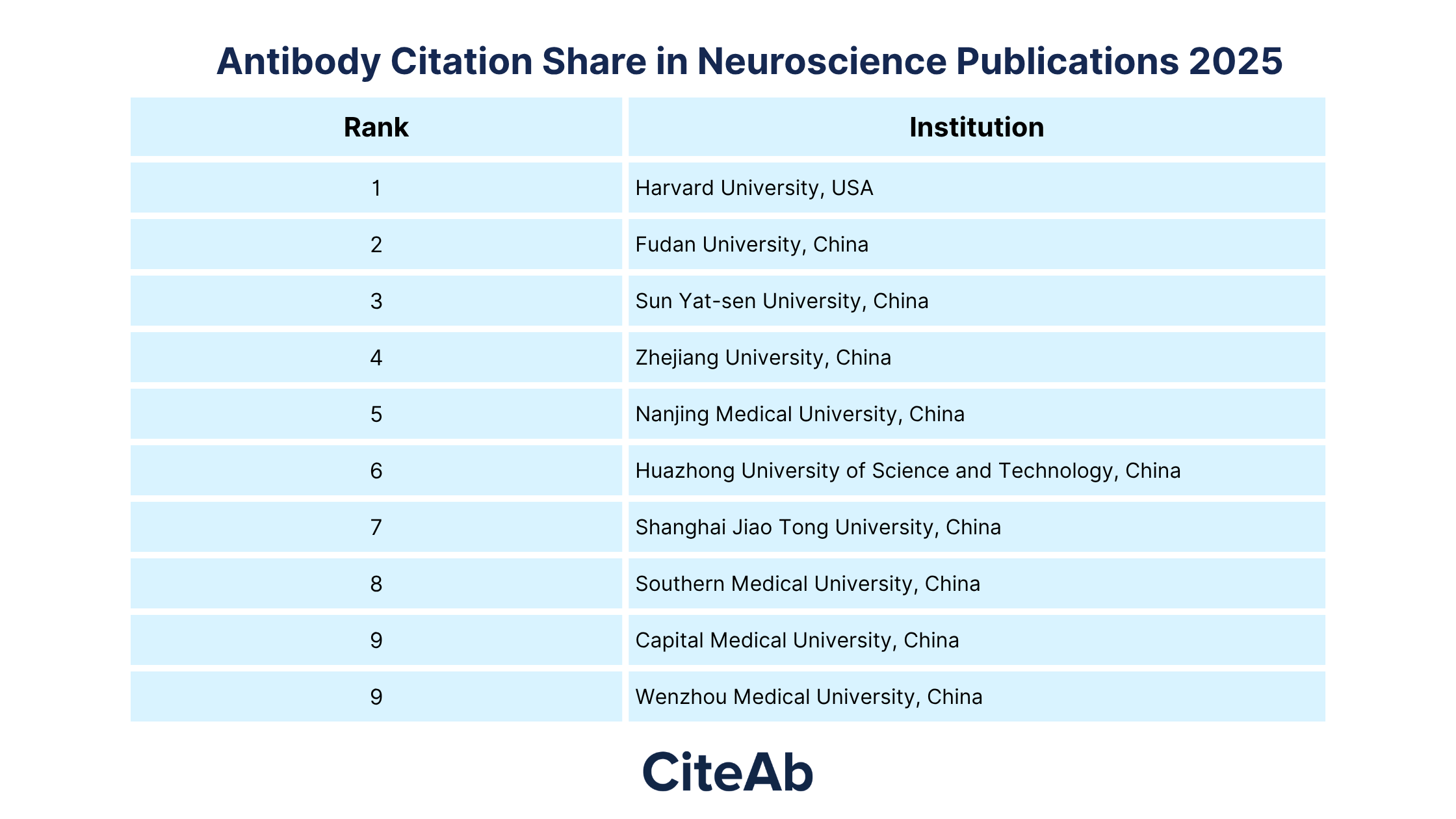
Harvard University takes the top spot, followed by Fudan University and Sun Yat-sen University.
The top 10 account for around 14% of antibody citations in neuroscience publications. Interestingly, when we drilled down further into share we found that no single institution in the top 10 completely dominated.
Do you know how many of your antibody citations come from these institutions, and how that compares with competitors?
You can freely download data on the top 50 institutes at the bottom of this blog.
Which regions are neuroscience research leaders?
Focusing on the top 10, 9 institutes were based in China. We have commented in the last few years on the growing research output – and corresponding reagent use – in Chinese institutions, and the neuroscience market reflects this change.
In fact, looking back over the past 12 years, the picture has changed dramatically. In 2014, 9 of the top 10 institutes by neuroscience antibody citations were based in the US.
Zooming out to the top 20, we saw that 4 institutions were now from the US: Johns Hopkins University, University of California, San Francisco and University of Texas, as well as Harvard at rank #1.
European Institutions dropped out of the top 20 entirely, with 5 new institutions from China breaking in.
These shifts are worth paying attention to: knowing where the heaviest antibody users are lets you check that your distribution, support and marketing actually reach them.

When we expanded the range of the data analysed to the top 100 institutions by citation share, we found that 13 different countries were represented.
Within Europe, Germany in particular caught our attention with strong antibody use amongst mid-sized institutions within or just beyond the top 100; including the University of Freiburg, Würzburg and Tübingen.
Neuroscience institutions to watch
Last time, we noted Sun Yat-sen University, Shanghai Jiao Tong University, Huazhong University of Science and Technology, and Zhejiang University were seeing standout growth.
Whilst these institutions remain in the top ten and significant antibody users, their positive growth trajectories have plateaued.
In this analysis, three different Chinese institutions stood out: Wenzhou Medical University, Fujian Medical University and Fudan University, amongst many more seeing impressive growth.

Growth, however, was not limited to just one region.
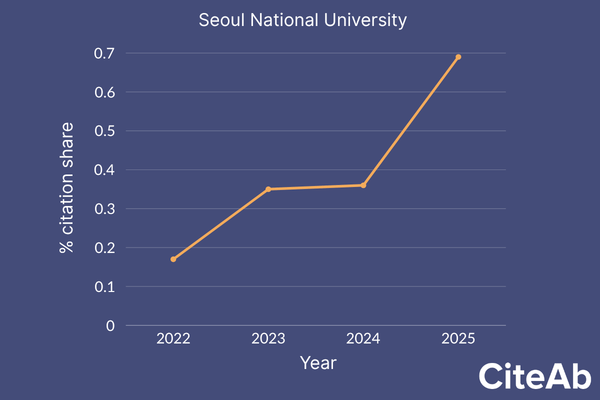
- The University of California, Irvine, moved into rank 26
- Yale University, moved to rank 27
- Seoul National University ranked just inside the top 30.
Could these institutions break into the top 20 in the future?
Neuroscience specialists to have on your radar
When we expanded our analysis beyond the top 50 neuroscience institutions, we found a number of interesting, more specialised institutions feature. A few from the many that ranked are named here:
- Ruhr-Universität Bochum, Germany, at rank 152. This institution is known for strong neuroscience research, which ranks above its overall university standing[1]
- ShanghaiTech University, China, at 157. A strong share given this institution is just 13 years old
- National Institute of Neurological Disorders and Stroke, USA, at 140 – a funder, representing a different type of organisation in this list

Making the most of SfN
Ahead of the biggest neuroscience meeting of the year, knowing where the research activity is concentrated in the antibody space can help you understand where the highest-volume users of neuroscience reagents are likely to be, and get ahead of trends in the wider market.
If you’d like to discuss this data, or any of our other market data services, with the CiteAb team some more at the meeting, just drop us an email here.
Plus, we’re giving away a free download of the top 50 institutions below. Simply sign up to receive the insights straight to your inbox!
Sign up for data
Something seems to have gone wrong while loading the form.
Drop us a message and we can send you the data directly.
References:
